How to Sublet in NYC: A Step-by-Step Legal Guide
How to Sublet in NYC: A Step-by-Step Legal Guide

Most NYC tenants have a legal right to sublet under New York Real Property Law §226‑b. The short answer is yes: you can sublet, but you must follow a specific process to stay protected. Start with two actions today: (1) prepare and send a certified-mail sublet request to your landlord with all required information, and (2) draft a signed sublease and gather your proposed subtenant’s ID and references. The NYC Rent Guidelines Board and NYS Homes and Community Renewal (HCR) both publish guidance on what that request must contain. For listing your unit quickly to vetted renters, Subletny is a curated option built specifically for this.
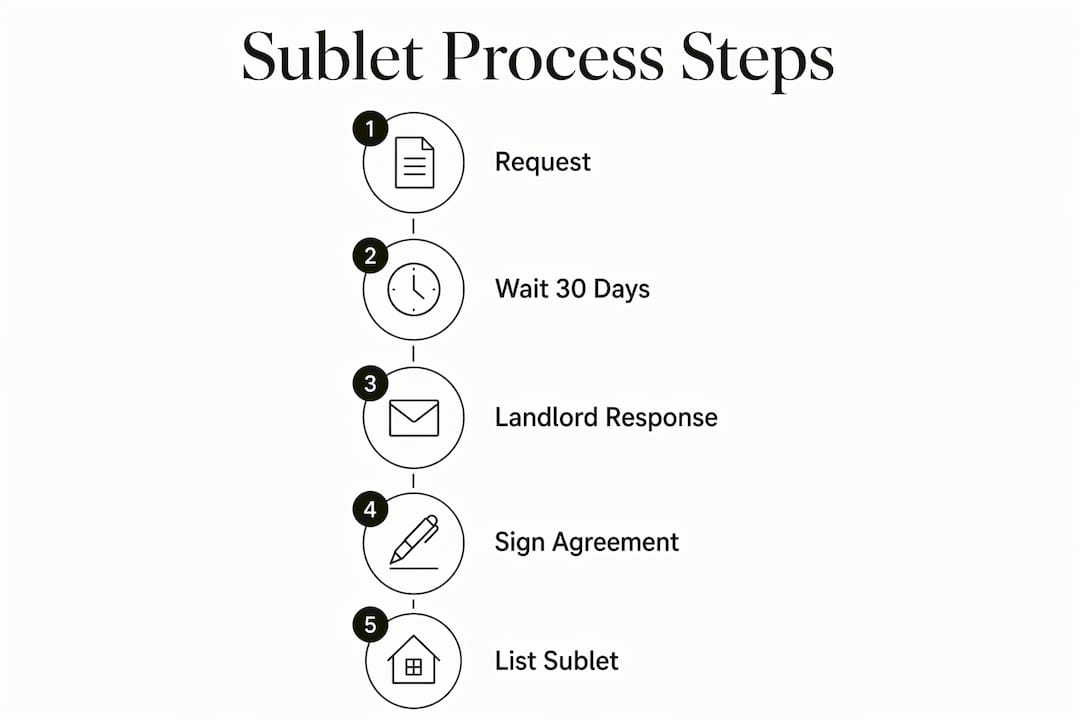
- Send a certified-mail sublet request at least 30 days before the proposed start date.
- Draft a sublease covering term, rent, utilities, deposit, and liability.
- Gather subtenant ID, references, and income verification before signing anything.
Table of Contents
- Does your apartment qualify for a legal sublet?
- How to request landlord permission (the 30-day timeline)
- What belongs in your sublease agreement
- How to screen a subtenant safely and avoid scams
- How to price your sublet and where to list it
- What to do if the landlord says no
- Key Takeaways
- The case for doing this right the first time
- List your sublet with Subletny, no broker fees required
- Authoritative sources and official resources
Does your apartment qualify for a legal sublet?
Not every NYC apartment falls under the same rules. HCR Fact Sheet #7 lays out the distinctions clearly, and they matter before you send a single letter.
Rent-stabilized units get the strongest statutory protections under RPL §226‑b. Your landlord cannot unreasonably deny a properly submitted request. Rent-controlled apartments operate under different rules: most rent-controlled tenants do not have existing leases, and the specific §226‑b procedures do not apply. You generally need the owner’s written consent, and the process is less structured. Subsidized housing, NYCHA, and Section 8 units are typically excluded from the standard subletting right entirely. Co-ops and condos add another layer: the building’s proprietary lease or house rules may restrict or prohibit subletting regardless of state law.
Key rule: Under RPL §226‑b, you must maintain the apartment as your primary residence during the sublet. If HCR or a court finds you have abandoned primary residency, the sublet can be classified as an illusory tenancy, which puts your lease at risk.
Two more limits apply to most tenants: the sublet term is capped at two years out of any four-year period, and any longer arrangement requires explicit written landlord approval. Pull your lease, confirm your tenancy type, and check whether any co-tenant or guarantor must also consent before you proceed.
How to request landlord permission (the 30-day timeline)
The process under RPL §226‑b is specific. Follow it exactly, because the timeline is what protects you.
- Draft the certified-mail request. Your written notice must include: the proposed sublet term (start and end dates); the subtenant’s full name, home address, and business address; your reason for subletting; your address during the sublet period; written consent from any co-tenant or guarantor; and a copy of your lease attached to the proposed sublease, acknowledged by both you and the subtenant as a true copy.
- Send by certified mail, return receipt requested. Keep the receipt and a full copy of everything you mailed. The 30-day clock starts from the date of mailing.
- Track the response window. The landlord has 10 days to request additional information. After that, they have 30 days from your original mailing (or from providing the additional info, whichever is later) to approve or deny in writing. If they do not respond within 30 days, that silence is legally deemed consent.
What counts as a reasonable denial? Objective, documented reasons: poor credit history, no stable income, or an incomplete request. What does not count: a vague objection, personal dislike, or no response at all. If you believe the denial is unreasonable, document everything and consult a tenants’ rights attorney before proceeding. Prevailing tenants can sometimes recover attorney’s fees when a court finds the landlord acted in bad faith.
What belongs in your sublease agreement
The sublease is your primary legal protection. A weak one leaves you exposed, since you remain fully liable to your landlord for rent, damages, and lease compliance throughout the sublet period.
Mandatory clauses to include:
- Exact term: start date, end date, and move-out procedure
- Rent amount, payment method, and due date
- Security deposit amount and return conditions
- Utility responsibilities (who pays what)
- Condition and inventory of the unit at move-in
- Landlord access rules (mirroring your original lease)
- Insurance and liability: the subtenant should carry renter’s insurance
- A clause stating the prime tenant remains liable to the landlord for all lease obligations
- Dispute resolution and default/cure language
- Attachment: a copy of the original lease, acknowledged as a true copy
For rent-stabilized units, state the rent clearly. If the unit is fully furnished, you may charge up to an additional 10% above the lawful rent for furniture use, per HCR Fact Sheet #7. Do not exceed that cap; overcharging a subtenant creates legal exposure.
Pro Tip: Require the subtenant to sign a written statement confirming the attached sublease is a true copy of the document submitted to your landlord. This small step aligns with HCR and Rent Guidelines Board expectations and protects you if a dispute arises later.
How to screen a subtenant safely and avoid scams
Screening is not optional. You are legally responsible for whoever occupies your apartment, so vetting your subtenant protects both your tenancy and your security deposit.
Screening checklist:
- Government-issued photo ID (verify it matches the name in the sublease)
- References from at least one prior landlord and one employer
- Proof of income or funds sufficient to cover rent
- Optional: background and credit check (obtain written consent first)
Scam warning: If a prospective subtenant refuses to meet in person or via video, pressures you to move faster than your timeline allows, or asks you to accept payment outside normal channels, treat it as a red flag. Legitimate renters understand the process takes time.
Document every communication in writing. Avoid cash-only arrangements. If something feels off about the ID or address information a prospect provides, ask for a second form of verification before signing anything.
Pro Tip: Keep all screening paperwork, consent forms, and ID copies on file. If your landlord later questions whether you properly vetted the subtenant, this documentation is your defense.

How to price your sublet and where to list it
Set your price by checking comparable furnished rentals in your neighborhood. For rent-stabilized units, the legal ceiling is your stabilized rent plus the sublet allowance set by the Rent Guidelines Board, and if the unit is fully furnished, you may add up to 10% to the lawful rent. Do not price above that, even if the market would bear it.
When preparing your listing, use clean, well-lit photos, accurate move-in and move-out dates, and clear information about transportation access and building rules. Renters searching for a sublet in NYC move quickly, so a complete listing gets responses faster.
| Channel | Best for | Notes |
|---|---|---|
| Subletny | Furnished short-term sublets | Curated, no broker fees, weekly newsletter distribution |
| University housing boards | Student subtenants | Free, but limited to campus networks |
| Community and neighborhood groups | Local renters | Broad reach, variable quality |
| General classified sites | Wide exposure | Higher scam risk; vet carefully |
One caution worth repeating: short-term rental platforms that encourage stays under 30 days may violate NYC’s short-term rental rules. Verify your building’s rules and local law before accepting any booking shorter than 30 days. Co-op and condo buildings often have stricter limits than the law requires.
For a vetted, broker-free option, browse current NYC sublets on Subletny to see how curated listings are structured and priced.
What to do if the landlord says no
A denial is not necessarily the end. How you respond depends on whether the denial is reasonable.
- If the denial cites missing information: provide it promptly and restart the 30-day clock.
- If the denial cites objective reasons (poor credit, incomplete request): those are likely reasonable. Do not proceed without legal advice.
- If the denial seems arbitrary or retaliatory: document the denial in writing, consult Met Council on Housing or a tenants’ rights attorney, and assess whether to challenge it.
- If the landlord never responds within 30 days: silence is deemed consent under RPL §226‑b. Keep your certified-mail receipt as proof before allowing the subtenant to move in.
If a court later finds the denial was unreasonable, you may recover costs. If the denial was reasonable and you proceeded anyway, the landlord can bring an eviction proceeding. Prepare a contingency plan: know how quickly the subtenant can vacate if needed.
Key Takeaways
Subletting in NYC is legally available to most rent-stabilized tenants who follow the certified-mail process under RPL §226‑b, maintain primary residency, and stay within the two-year sublet limit.
| Point | Details |
|---|---|
| Certified mail is required | Send the landlord a written request by certified mail at least 30 days before the sublet starts. |
| Silence equals consent | If the landlord does not respond within 30 days, the request is legally deemed approved. |
| Prime tenant stays liable | You remain responsible for rent, damages, and lease compliance throughout the entire sublet. |
| Furnished premium is capped | For rent-stabilized apartments, a maximum of 10% above the lawful rent can be added for a fully furnished unit. |
| Subletny simplifies listing | Subletny offers curated, broker-free listings and a weekly newsletter to connect you with vetted renters fast. |
The case for doing this right the first time
Subletting in NYC has a reputation for being complicated, and that reputation is mostly earned. The legal framework is real, the timelines matter, and the consequences of skipping steps range from a lost security deposit to an eviction proceeding. What we see consistently is that tenants who run into trouble did not fail because the law is unfair. They failed because they treated the certified-mail requirement as a formality, skipped the sublease, or found a subtenant through an unvetted channel and hoped for the best.
The 30-day deemed-consent rule is genuinely powerful. It means a landlord who ignores your properly submitted request has no legal ground to stop you. But that protection only works if you can prove delivery, and that means keeping every receipt. The sublease is equally non-negotiable: without one, you have no documented basis for recovering your security deposit from the subtenant or defending yourself if the landlord claims damage.
We built Subletny specifically because the listing side of this process was broken. Tenants who had done everything right legally were still losing weeks trying to find a subtenant through channels full of scams and unresponsive leads. A curated, broker-free platform with over 300 users in the network changes that math.
List your sublet with Subletny, no broker fees required
If you have completed the legal steps and are ready to find a subtenant, Subletny is the fastest way to reach vetted, serious renters in New York City. Unlike general classified sites, every listing goes through a curation process and is distributed through a weekly newsletter to renters actively looking for furnished short-term apartments. No broker fees, no hidden costs, and direct contact between you and the renter.
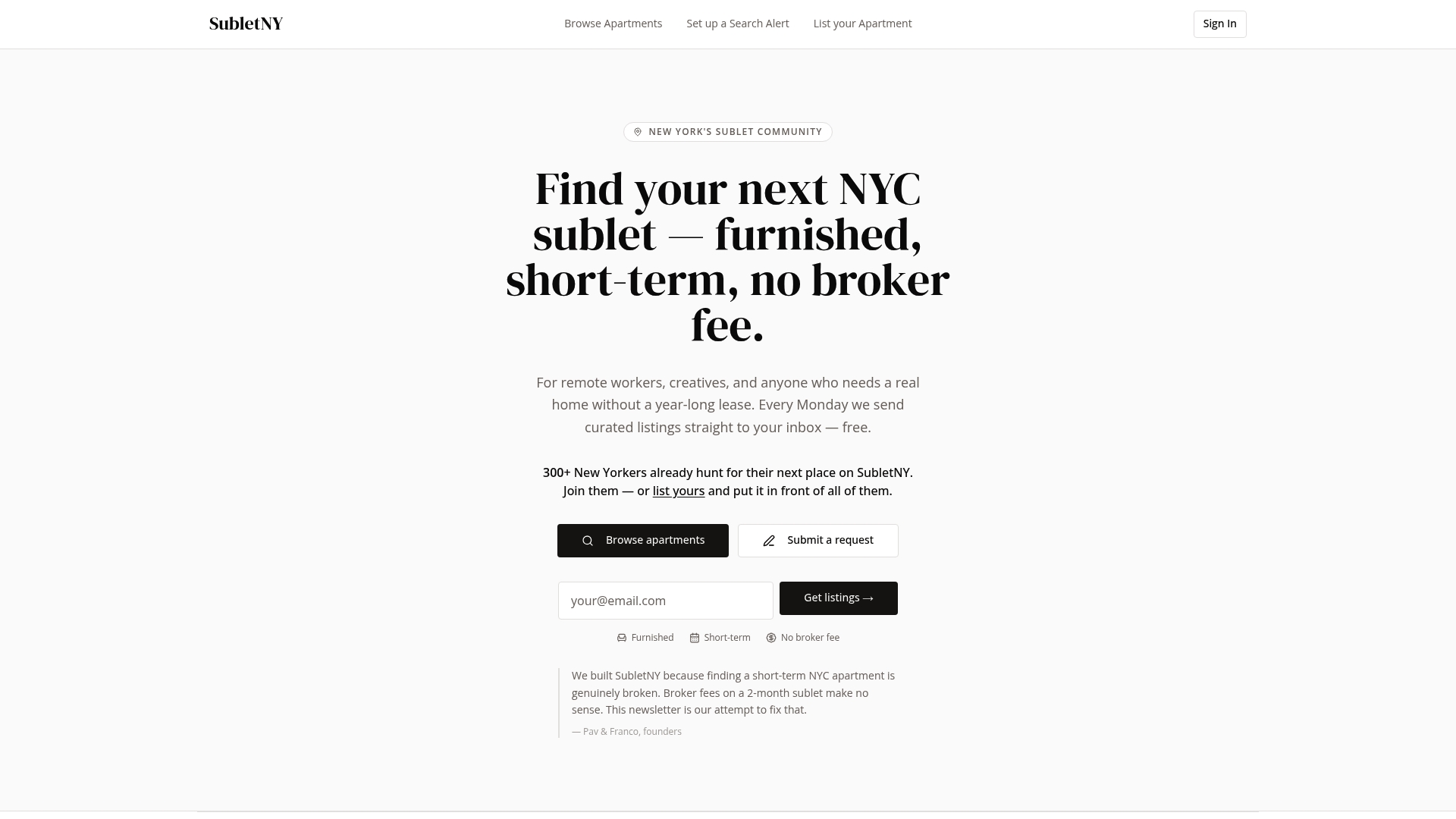
Over 300 New Yorkers already use Subletny to find and fill short-term sublets. The listing flow is quick, and optional featured placement puts your unit at the top of the weekly send. List your NYC sublet today and start connecting with renters who are ready to move.
Authoritative sources and official resources
| Resource | What it provides |
|---|---|
| RPL §226‑b — NY State Senate | Full statutory text: required request contents, timelines, and tenant remedies |
| HCR Fact Sheet #7 | Procedural guidance, primary residency rules, furnished rent allowance, and forms |
| NYC Rent Guidelines Board — Subletting FAQs | Required request contents, 30-day rule, 10% furnished premium explanation |
| Met Council on Housing — Subletting | Exceptions (public housing, co-ops), practical tenant checklist, two-year limit |
| NYC Bar — Subleases and Roommates | Unreasonable denial remedies, attorney’s fees, prime tenant liability |
| Subletny — List your sublet | Listing process, curation standards, and newsletter distribution details |
This article is general information, not legal advice. Subletting rules vary by tenancy type and building. Confirm current requirements with HCR, the Rent Guidelines Board, or a qualified housing attorney before proceeding.